Published September 29, 2022 | Last updated July 29, 2026
For one typical 13,500- or 15,000-BTU travel trailer air conditioner, I recommend a generator with roughly 3,000 to 4,500 running watts.
A 2,000- to 2,200-watt generator may run one RV A/C if the air conditioner has a properly installed soft start and you carefully manage every other electrical load. But that setup leaves very little room for the battery charger, refrigerator, microwave, coffee maker, or anything else that turns on unexpectedly.
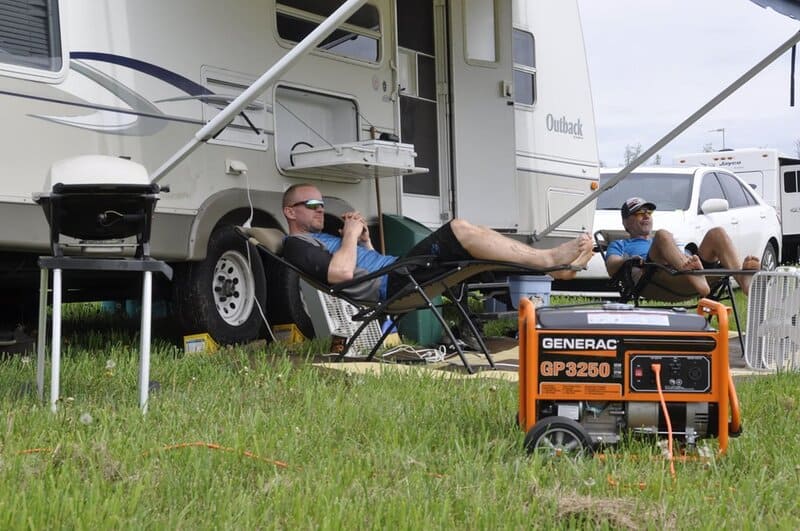
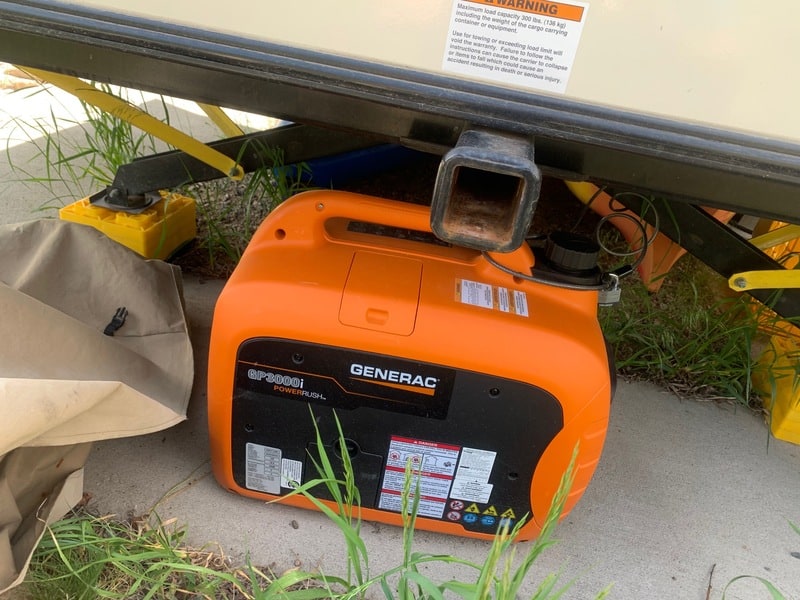
For most RV owners, a 3,500- to 4,500-watt dual-fuel inverter generator is the sweet spot. It gives you enough power for one A/C plus some normal RV loads without becoming as ridiculously large and heavy as the generator Susan and I bought.
The Quick Generator Size Guide
- One small RV A/C with a soft start: 2,000 to 2,500 watts may work, but power management is critical.
- One 13,500- or 15,000-BTU A/C: 3,000 to 4,500 running watts is the safer all-around range.
- One A/C plus microwave, coffee maker, or other heavy loads: about 4,000 to 5,500 running watts, or run the heavy appliances separately.
- Two rooftop A/C units: usually 5,500 to 7,000 or more running watts, soft starts on both units, and careful load management.
- A full 50-amp trailer: no normal portable generator duplicates full 50-amp campground service. Decide which loads you actually need to run.
These are starting points, not guarantees. The correct answer comes from the data plates on your A/C and appliances, the generator’s rated running output, elevation, outside temperature, fuel type, and whether the A/C has a soft start.
Why Starting Watts Matter More Than Most People Realize
An RV air conditioner does not use the same amount of power every second.
The compressor needs a short burst of extra power when it starts. That initial surge can overwhelm a small generator even if the generator has enough power to keep the A/C running afterward.
That is why generator advertising can be confusing. You will usually see two ratings:
- Starting or surge watts: the short maximum burst the generator can provide.
- Running or rated watts: the continuous power the generator can supply.
Size your generator around the running watts you need, then make sure it has enough surge capacity to start the A/C.
Do not rely only on the A/C’s BTU rating. Check the model’s data plate or manual for rated amps and electrical requirements because two 15,000-BTU units can have different power demands.
Our 7,000-Watt Propane Generator Is Awesome and Way Too Big
Susan and I own a Sportsman GEN7000LP propane generator. It produces 7,000 surge watts and 6,000 running watts.
It is a beast. It will run heavy RV loads, and in our experience it can run for about 11 hours on a standard grill-size propane cylinder under a substantial load.
But it is also much larger, heavier, and louder than most travel trailer owners need. If I were buying specifically for one travel trailer A/C today, I would not automatically buy another 7,000-watt open-frame generator.
I would look hard at a 3,500- to 4,500-running-watt dual-fuel inverter generator instead. That size is easier to move, usually much quieter, provides cleaner power for electronics, and is still large enough for one rooftop A/C with a reasonable cushion.
Why I Prefer Propane Fuel for an RV Generator
The best lesson we learned from our Sportsman generator is that propane is the fuel I prefer for an RV generator that may sit unused for long periods.
Gasoline can go stale and leave deposits in the carburetor if it sits. That is one reason gasoline generators can become difficult to start after months in storage.
Propane does not go stale in the cylinder. Our generator can sit for a long time and still start without dealing with old gasoline in the carburetor. We have occasionally cleaned the spark plug after storage and had it fire right up.
I would still follow the generator manufacturer’s maintenance instructions rather than assuming propane eliminates maintenance. You still need to check the oil, spark plug, air filter, hoses, regulator, and connections.
Also remember that many dual-fuel generators produce fewer running watts on propane than on gasoline. Use the propane rating—not the larger gasoline number—when deciding whether a generator can run your A/C.
A More Portable Generator I Would Consider
A current example of the size I would consider is the Champion 4,500-Watt Electric Start Dual Fuel Inverter Generator.
On propane, it is rated at 4,500 starting watts and 3,150 running watts. It has an RV-ready 30-amp outlet, clean inverter power, a carbon monoxide shutoff system, wheels, electric start, and a quieter enclosed design.
It still weighs about 99 pounds, so I would not call it light. But it is much more realistic for travel trailer camping than our large open-frame Sportsman.
I am using that as an example of the category, not pretending we personally own that Champion model. Compare current dual-fuel inverter models from Champion, Westinghouse, Honda, Yamaha, and other established brands before buying.
Can a 2,000-Watt Generator Run an RV A/C?
Sometimes—but I would not promise it.
A 2,000- or 2,200-watt inverter generator may start and run one efficient rooftop A/C when all of these are true:
- The A/C has a properly installed soft start.
- The converter or battery charger is not pulling heavily.
- The refrigerator and water heater are not running on electricity.
- The microwave, coffee maker, and hair dryer are off.
- The generator is not badly derated by heat or elevation.
That is too many conditions for me to call a 2,000-watt generator the best general recommendation. It can be a lightweight solution for someone who understands power management, but it is not the forgiving choice.
Why We Installed Micro-Air EasyStarts
We have Micro-Air EasyStart soft starts on both rooftop A/C units in our Class A motorhome.
They were installed when we added our solar system, and they made a real difference.
Before the soft starts, 30-amp campground service was a problem. We could have one A/C running, but when the compressor on the second unit tried to start, the breaker would trip.
The EasyStarts reduce the compressor’s startup demand. That does not reduce the A/C’s normal running load, and it does not create free electricity. But it makes that startup surge much easier for a generator, inverter, or limited campground connection to handle.
A soft start is especially useful if you want to:
- Run an A/C from a smaller generator.
- Run two A/C units on limited shore power when the total running load permits.
- Reduce the harsh thump when the compressor starts.
- Run an A/C from a properly sized inverter and battery system.
Use our Micro-Air EasyStart Amazon link to see the current model and pricing. Confirm compatibility with your exact A/C before ordering.
What Size Generator for Two RV Air Conditioners?
Two rooftop A/C units change the equation quickly.
Two 13,500- or 15,000-BTU units can easily use 3,000 watts or more while both compressors are running. Then you must add the converter, refrigerator, televisions, water heater, and anything else operating inside the trailer.
I would generally look at 5,500 to 7,000 or more running watts for two A/C units, preferably with a soft start on each A/C. Even then, I would stagger the compressor startups and avoid using the microwave or other large heating appliances at the same time.
Another option is two smaller parallel-capable inverter generators. That can be easier to lift because you move two lighter machines instead of one huge generator. It also lets you run only one generator when you do not need full power.
What Size Generator for a 50-Amp Travel Trailer?
A 50-amp RV connection can theoretically deliver up to 12,000 watts because it has two 120-volt, 50-amp legs.
That does not mean every 50-amp trailer needs a 12,000-watt generator. It means the trailer is capable of using far more power than most portable RV generators can provide.
Decide what you actually need:
- One A/C and basic loads may work on a 3,500- to 4,500-running-watt generator.
- Two A/C units may need 5,500 to 7,000 or more running watts.
- Running both A/Cs, the electric water heater, microwave, residential refrigerator, and other major loads may require a very large generator or strict load management.
A 50-amp-to-30-amp adapter does not create more power. It only allows the trailer to connect to a smaller source, so you must manage the loads accordingly.
Do You Need a Surge Protector With a Generator?
I use a Progressive Industries EMS-PT50X portable electrical management system for our 50-amp motorhome.
I would use electrical protection with campground shore power every time. With a portable generator, compatibility can depend on how the generator’s neutral and ground are configured. Some EMS units may report an open-ground fault on a generator with a floating neutral.
Do not randomly bypass an EMS or install a bonding plug without checking the manuals for the generator, RV, transfer equipment, and EMS. Grounding and neutral bonding are electrical safety issues, not internet guesswork.
Basic Surge Protector vs. Full EMS
People call almost every pedestal protection device a “surge protector,” but there are two very different levels.
Budget Level: Progressive Industries SSP-30XL or SSP-50XL
The less expensive Progressive Industries SSP models provide surge protection and indicator lights for common pedestal wiring faults such as an open ground, open neutral, or reverse polarity.
We use the Progressive Industries SSP-30XL on our Class C RV and it has worked great for years.
It is much better than plugging the RV directly into an unknown pedestal.
But these basic units do not provide the same automatic protection as a full EMS. They do not continuously disconnect your RV every time voltage becomes dangerously low or high.
Better Protection: Progressive Industries EMS-PT30X or EMS-PT50X
The more expensive EMS models add active protection. They monitor the incoming power and can shut it off when they detect damaging low voltage, high voltage, an open neutral, reverse polarity, incorrect frequency, or other electrical faults.
They also delay reconnection after an interruption to protect the A/C compressor.
That is why I consider a full EMS the better buy. A simple surge is not the only thing that can damage an RV. Low campground voltage can be especially hard on air conditioners.
My recommendations are:
- Budget 30-amp option: Progressive Industries SSP-30XL, which I use on our Class C RV.
- Premium 30-amp option: Progressive Industries EMS-PT30X.
- Budget 50-amp option: Progressive Industries SSP-50XL.
- Premium 50-amp option: Progressive Industries EMS-PT50X, which is the model I use on our Class A RV.
The Hughes Power Watchdog EPO models are another strong premium option. The important letters are EPO, which indicate emergency power shutoff. Hughes also offers less expensive monitoring models that do not automatically disconnect power, so read the model name carefully.
How to Calculate Your Generator Size
- Find the running amps or watts on the A/C data plate.
- Multiply amps by volts when you need to estimate watts.
- Add the wattage of every appliance that may run at the same time.
- Include the converter and battery charger, especially when the batteries are low.
- Add a reasonable cushion instead of buying a generator that operates at its limit.
- Confirm that the generator’s surge rating can start the A/C compressor.
- Use the generator’s propane output rating if you plan to run on propane.
As a rough example, a 15-amp A/C operating at 120 volts uses about 1,800 watts while running. That does not include the startup surge or any other RV loads.
Easy Ways to Keep From Overloading the Generator
- Run the refrigerator and water heater on propane when appropriate.
- Let the A/C start before adding other loads.
- Turn the A/C off briefly before using the microwave, hair dryer, or coffee maker when generator capacity is tight.
- Keep the A/C filter and rooftop coils clean.
- Charge deeply discharged batteries before expecting the generator to handle the A/C and every appliance.
- Use a voltmeter or EMS to watch for low voltage.
- Expect less generator output at high elevation and in extreme heat.
Generator Safety Is Not Optional
A portable generator can produce deadly carbon monoxide. Never run one inside the RV, a storage bay, truck bed with a closed cap, garage, tent, or any enclosed area.
- Operate it outside and far away from windows, doors, and vents.
- Point the exhaust away from your RV and neighboring campsites.
- Keep working carbon monoxide alarms inside the RV.
- Follow the manufacturer’s rain and wet-weather instructions.
- Let the generator cool before refueling or changing propane cylinders.
- Respect campground generator hours and noise limits.
Newer generators with an automatic carbon monoxide shutoff add useful protection, but that feature does not make indoor or close-to-the-RV operation safe.
My Bottom Line
For most travel trailer owners who want to run one rooftop A/C, I think a 3,500- to 4,500-running-watt dual-fuel inverter generator is the best balance of power, portability, noise, and convenience.
A 2,000-watt generator can work in the right setup, especially with a Micro-Air EasyStart, but it leaves very little margin.
Our 7,000-watt Sportsman propane generator has been powerful and dependable, but it is more generator than most travel trailers need. The part I would absolutely choose again is propane—or at least a dual-fuel model—because propane stores cleanly and avoids many of the headaches caused by old gasoline.
Before buying, check the actual electrical requirements of your A/C, decide what else must run at the same time, and buy enough generator to leave yourself some breathing room.
Related Reading:
- 25 Campground Rules Everyone Should Follow
- RV Propane Not Flowing? 7 Things to Check Safely
- How Long Does an RV Propane Tank Last?
About the Author:
Hi, I’m Mike Scarpignato, co-founder of TravelTrailerPro.com, RVBlogger.com, and MotorhomeFAQs.com.
My wife, Susan, and I have been creating RV content since 2018. We travel the country visiting RV shows, touring dealerships, reviewing campers, testing gear, and spending plenty of time camping in our motorhome. Most of what we share comes from actually using RVs, making mistakes, fixing problems, and learning what works in the real world.
Susan is usually behind the camera on our RVBlogger YouTube channel, which has more than 215,000 subscribers. We also run RV Camping for Newbies, a private Facebook group with more than 275,000 members, and publish four weekly RV newsletters reaching more than 85,000 subscribers.
Our goal is simple: help beginners and experienced RVers choose the right RV, avoid expensive mistakes, and enjoy the RV lifestyle with a little less frustration.