Article Updated October 6, 2025
Airstream travel trailers have always fascinated me. There’s just something about that shiny aluminum body and timeless shape that grabs your attention. Whether you’re an RVer or not, you know an Airstream when you see one.
So when I had the opportunity to interview an Airstream salesman who’s worked with the brand for over 30 years—and even owned a few himself—I jumped at the chance to finally answer a question I’ve always had: How are Airstreams made?
The answer? With a level of craftsmanship that’s practically unheard of in the RV world today.
What Makes an Airstream So Iconic
Airstream is the oldest travel trailer brand still in production, dating back to the 1920s. Founder Wally Byam started out building Masonite trailers before switching to lightweight aluminum inspired by aircraft construction. The result was that distinctive “silver bullet” design meant to reduce drag, improve gas mileage, and turn heads wherever it goes.
The first Airstreams even had features unheard of at the time—electric lights and a built-in water system. Over the years, they’ve survived the Great Depression, World War II material shortages, and countless design fads. Yet through it all, Airstream never lost its identity.
Today, every single Airstream travel trailer is still hand-built in Jackson Center, Ohio, where craftspeople use techniques that go all the way back to Wally Byam’s day.
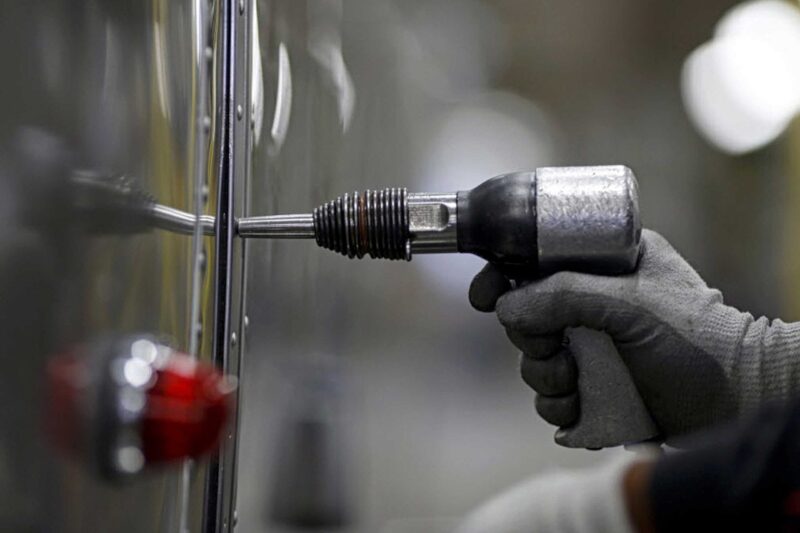
“Every rivet is still done by hand,” my Airstream contact told me. “It’s a two-person job—one inside, one outside. They’ve got to work in sync, rivet by rivet, until the shell is complete. No robots. Just skill.”
Why Airstreams Are So Expensive
Let’s get the elephant out of the room: yes, Airstreams are pricey. But after talking with someone who’s been in the industry for decades, I can confidently say—they’re worth it.
Unlike most RVs that roll down automated assembly lines, Airstreams are individually assembled by hand. Each travel trailer takes over 350 hours to complete. Every piece of cabinetry, every window, and every inch of aluminum is crafted, fitted, and tested by real people who take pride in their work.
“You’re not paying for hype,” the salesman said. “You’re paying for 90 years of craftsmanship that’s never been automated.”
He also pointed out that Airstreams hold their value better than almost any other RV brand. Because production is limited and quality is high, there’s always demand. That’s why you’ll often see vintage Airstreams selling for as much—or more—than some newer models.
Behind the Scenes: Touring the Airstream Factory
I haven’t met an RVer yet who isn’t curious about how these aluminum beauties come together. After seeing the process firsthand, I can tell you—it’s part engineering marvel, part art project.
Behind the Scenes: Airstream Factory Fast Facts
- Over 350 hours of hand labor go into each travel trailer
- More than 3,000 rivets installed by hand per unit
- 12,000 gallons of water used during leak testing
- Frames, furniture, and cabinetry are custom-built in-house
- The process has changed very little in over 90 years
“It’s like watching an orchestra at work,” I was told. “Everyone knows their role. Every rivet, every wire, every cabinet—it all has to fit perfectly inside that curved shell.”
Here’s what goes into building each Airstream travel trailer from the ground up.
1. The Frame and Floor
Each Airstream starts with a specially engineered chassis that houses the tanks and supports the shell. The flooring material is a marine-grade composite—lightweight, waterproof, and built to last far longer than wood. The entire floor is leveled on a floating platform before any walls are added.
2. The Riveted Aluminum Shell
This is the step that defines the Airstream brand. Each trailer is made from five main body sections—front, rear, sides, roof, and underbelly—formed from aircraft-grade aluminum. The panels are hand-riveted together by teams of two, one inside and one outside. Larger trailers can have over 3,000 rivets, and yes, they’re all installed by hand.
3. Attaching the Shell to the Frame
Once the iconic shell is complete, it’s carefully lifted and attached to the frame. This process ensures that the body is perfectly balanced and true. At this point, the Airstream starts to look like the familiar silver bullet we all recognize.
4. Testing for Leaks
Next comes one of my favorite steps: the “rain test.” Each trailer is blasted with 12,000 gallons of water for 25 minutes in a sealed chamber. A technician sits inside, watching for any signs of leaks. If there’s even the smallest drip, it goes back for repairs before moving on.
5. Insulation and Interior Shell
Once watertight, the team installs EcoBatt insulation, made from recycled glass and sand—an eco-friendly choice that also provides great thermal performance. Then a second layer of aluminum sheeting goes inside the trailer, creating that sleek, riveted interior Airstreams are known for.
6. Systems and Wiring
After insulation, the electrical, plumbing, and gas systems are installed. Each wire and pipe is carefully routed to remain hidden but easily serviceable. This step also includes adding heating and cooling components, solar wiring, and control panels.
7. Custom-Made Interiors
Airstream builds all of its cabinetry, upholstery, and furniture in-house. Each piece is handcrafted to fit the exact curvature of the trailer—nothing off-the-shelf. This is where the attention to detail really shows.
“We still build furniture like we’re fitting a yacht,” the salesman said. “Everything curves with the shell—it’s not square, so it takes skill.”
8. Final Quality Control
Before any Airstream leaves the factory, it goes through a meticulous quality control process. Every light, outlet, faucet, and appliance is tested. If anything’s even slightly off, the finishing crew fixes it on the spot. Only when it passes inspection is it cleared for delivery.
Do Airstreams Hold Their Value?
Absolutely. One of the key things my interview confirmed is that Airstreams are built to last decades, not just years. Because the materials and design hold up so well, used and vintage models stay in high demand.
Many owners upgrade older Airstreams with modern features—solar panels, lithium batteries, smart lighting, and more—and resell them for top dollar. A well-maintained 1970s model can still command a high price because the bones are so solid.
“You can’t say that about many RVs,” my Airstream expert said. “You’ll still see 50-year-old Airstreams on the road today. That tells you everything you need to know.”
The Most Affordable Airstream Models
If you’re thinking about buying an Airstream, the Basecamp is the most affordable option, starting around $47,000 and sleeping up to four. On the other end of the spectrum, the Classic offers luxury living for five people and starts around $200,000.
There are plenty of models in between—from the lightweight Caravel and Flying Cloud to the high-end Globetrotter—so there’s something for every type of traveler and budget.
Final Thoughts: Why Airstreams Are Still Handcrafted Legends
After learning how Airstreams are made and talking with someone who’s lived and breathed the brand for decades, I understand the price tag. You’re not just buying a travel trailer—you’re investing in craftsmanship, heritage, and quality that lasts generations.
Every Airstream that rolls out of Jackson Center is a testament to American engineering and pride. It’s not hype—it’s hands, heart, and history coming together one rivet at a time.
“There’s a reason people still dream about owning an Airstream,” my contact told me. “It’s not just an RV—it’s part of who you become on the road.”
Related Reading:
– How To Properly Wax Your Airstream Travel Trailer
– 6 Airstream Alternatives To Save You Money
– Do Airstreams Have Slide-Outs?
– Why Are Molded Fiberglass Campes So Small?
About the Author:
Hi, I’m Mike Scarpignato, co-founder of TravelTrailerPro.com, RVBlogger.com, and MotorhomeFAQs.com.
My wife, Susan, and I have been creating RV content since 2018. We travel the country visiting RV shows, touring dealerships, reviewing campers, testing gear, and spending plenty of time camping in our motorhome. Most of what we share comes from actually using RVs, making mistakes, fixing problems, and learning what works in the real world.
Susan is usually behind the camera on our RVBlogger YouTube channel, which has more than 215,000 subscribers. We also run RV Camping for Newbies, a private Facebook group with more than 275,000 members, and publish four weekly RV newsletters reaching more than 85,000 subscribers.
Our goal is simple: help beginners and experienced RVers choose the right RV, avoid expensive mistakes, and enjoy the RV lifestyle with a little less frustration.